
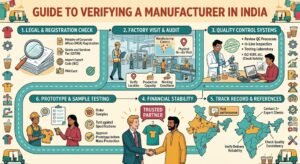

Finding a supplier offering a good wholesale rate is relatively easy. Finding out whether that supplier is actually the manufacturer is a different matter altogether.
This becomes especially important when you are sourcing through WhatsApp, B2B portals, Google, social media or referrals and the supplier asks for a 30%, 50% or even 100% advance payment before production.
A professional website, GST number and photographs of machinery may look reassuring, but none of these individually proves that the seller owns or operates the factory shown to you.
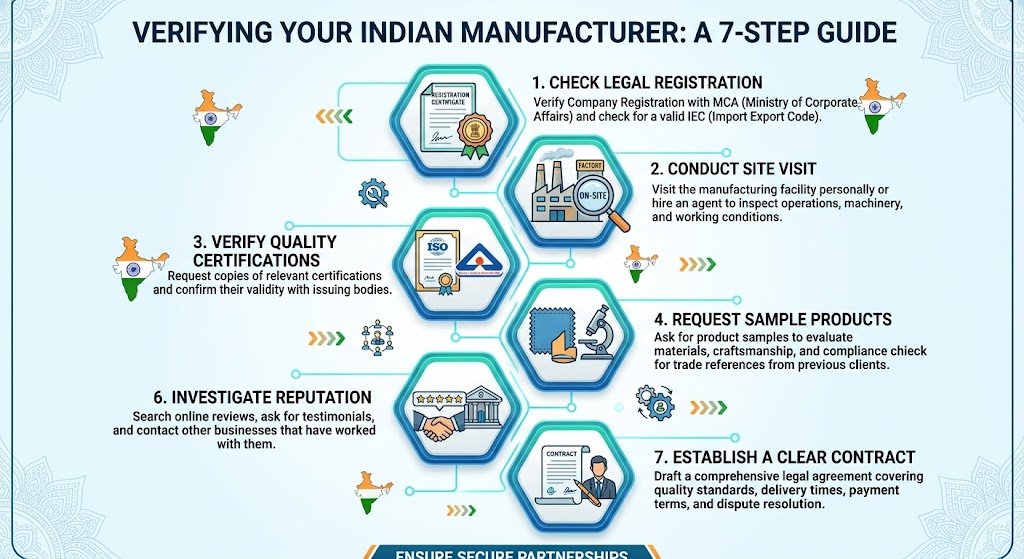
For buyers using wholesale-rates.com to research wholesale products and sourcing options, price should therefore be only one part of the buying decision. Before sending money, you should verify the business, the people behind it, the production facility and the bank account receiving your payment.
Here is how to verify a manufacturer in India systematically.
How Can I Verify an Indian Manufacturer? 12 Checks Before Ordering
If you need the short answer, use these twelve checks:
- Verify the supplier’s GST registration.
- Match the GST legal name with quotations and invoices.
- Check company, LLP, partnership or proprietorship details.
- Confirm the factory address independently.
- Ask for a live factory video call or physical inspection.
- Ask about machinery, workers, capacity and production process.
- Verify product-specific licences or certifications where required.
- Match the invoice name with the beneficiary bank-account name.
- Order samples or a small trial batch before bulk production.
- Check genuine trade and customer references.
- Issue a detailed written purchase order.
- Structure advance payments around measurable milestones.
Think of supplier verification as a chain. A GST number alone is not enough. A factory video alone is not enough. A sample alone is not enough.
The more independent details that match, the lower your sourcing risk becomes.
1. GST Supplier Verification: Start With the GST Number
One of the easiest ways to verify a wholesale supplier in India is to ask for its GSTIN.
Do not simply accept a GST certificate sent as a PDF or WhatsApp image. Check the number independently through the official GST system.
The GST taxpayer search can provide information including the legal name, trade name, constitution of business, registration date, principal place of business and cancellation information, while additional information may be available to logged-in users. (GST Tutorial)
Compare these details with:
- supplier quotation;
- proforma invoice;
- company website;
- email signature;
- bank beneficiary;
- factory address;
- visiting card.
What should worry you?
Suppose you are buying garments from ABC Garments in Tiruppur, but the GST search shows the legal entity as XYZ Trading Enterprises, with its principal place of business somewhere completely different.
That does not automatically mean fraud. Businesses legitimately use trade names, multiple locations and different legal structures.
But it does mean you should ask for an explanation before transferring money.
Remember that a trade name can differ from the legal business name under GST. (GST Tutorial)
GST supplier verification is therefore an identity check—not proof that the business manufactures the goods.
2. Check the Legal Business Name
A surprisingly useful rule when learning how to verify a manufacturer in India is:
Follow the legal name, not just the brand name.
A supplier might introduce itself as:
Royal Home Furnishings
But its actual legal entity may be:
RK Textiles Private Limited
That can be perfectly legitimate.
The important question is whether you can establish a clear connection between the brand, legal entity, GST registration, quotation, factory and bank account.
Ask the supplier:
- What is your legal business name?
- What is your GSTIN?
- What type of business entity are you?
- Who owns the business?
- What is the registered address?
- What is the factory address?
- In whose name will the invoice be issued?
- In whose name will payment be received?
Put the answers into one supplier file and look for inconsistencies.
3. Verify Company, LLP or Partnership Registration
The next factory verification checklist item depends upon the supplier’s business structure.
Private Limited or Limited Company
Search its details through the Ministry of Corporate Affairs’ company records.
MCA master data allows buyers to check registered company information and company status. (MCACDM)
Look for consistency in the:
- company name;
- incorporation details;
- registered office;
- company status;
- corporate identification details.
LLP
Limited Liability Partnerships can similarly be checked through MCA records.
Partnership Firm
Traditional partnership firms operate under a different framework from companies and LLPs. The Indian Partnership Act provides for registration and maintenance of firm details through Registrars of Firms, and state-level procedures may apply. (India Code)
Ask for the partnership deed and registration details where applicable.
Proprietorship
A sole proprietorship will not have a company CIN simply because it is not a company.
Instead, cross-check documentation such as:
- GST registration;
- Udyam registration, where available;
- invoices;
- business bank account;
- applicable local licences;
- proprietor details.
Do not reject a supplier simply because it is a proprietorship. Thousands of genuine Indian manufacturing businesses operate under relatively simple legal structures.
Your objective is consistency, not necessarily corporate sophistication.
4. Confirm the Factory Address
This is where manufacturer versus trader verification becomes much more useful.
Ask separately for the supplier’s:
- registered office;
- sales office;
- warehouse;
- manufacturing unit.
They may legitimately be different.
Then check whether the claimed factory location makes sense.
Ask for:
- complete postal address;
- Google Maps location pin;
- photographs of the entrance;
- exterior factory photograph;
- signage showing the company name;
- factory floor photographs;
- recent dispatch photographs.
You can also search the location online and examine available satellite imagery, business listings and street-level information.
For a large wholesale order, a physical factory visit or independent inspection is far stronger than photographs.
Remember: a warehouse is not necessarily a factory
Rows of cartons prove that somebody has inventory.
They do not prove who manufactured it.
5. Ask for a Live Factory Video Call
A live video call is one of the simplest practical tools when you need to verify a manufacturer in India remotely.
Do not ask the supplier merely to send another factory video.
Ask for a live WhatsApp, Google Meet or video call from the production floor.
During the call, request that the representative walk continuously through:
- factory entrance;
- production floor;
- machinery;
- raw-material storage;
- work-in-progress area;
- quality-control section;
- packaging area;
- finished-goods area.
Ask questions spontaneously.
For example:
“Can you show me the machine used for this particular product?”
Or:
“Can you show today’s production batch?”
A genuine manufacturer should generally be able to explain how its products are made.
Be more cautious when the salesperson repeatedly says the factory is inaccessible, photography is impossible, every machine is somewhere else or a video call can never be arranged.
There can be legitimate confidentiality or safety restrictions, but repeated avoidance deserves further verification.
6. Ask About Machinery, Production and Factory Capacity
A trader usually knows the product.
A manufacturer should know the production process.
Ask:
- What raw materials are used?
- Which operations happen in-house?
- Which operations are outsourced?
- What machines are used?
- How many production lines are available?
- What is normal monthly production?
- What is the minimum order quantity?
- What is the typical production lead time?
- What quality checks are performed?
- Which stages are subcontracted?
Suppose a supplier claims it can manufacture 100,000 units every week but appears to operate from a tiny facility with two machines.
Ask questions.
Production capacity should broadly make sense when compared with the equipment, workforce and lead time being quoted.
Also remember that partial outsourcing is normal in Indian manufacturing. A genuine manufacturer may outsource printing, plating, embroidery, heat treatment, packaging or other specialised operations.
The important issue is transparency.
Manufacturer Versus Trader: How to Tell the Difference
Being a trader is not inherently bad.
Traders, wholesalers and merchant exporters perform useful functions by consolidating products, managing smaller MOQs and connecting buyers with multiple factories.
The problem arises when a trader falsely presents itself as the manufacturer.
| Check | Typical Manufacturer | Typical Trader |
|---|---|---|
| Production facility | Usually has own or controlled production | Usually sources from other factories |
| Machinery knowledge | Detailed | Often limited |
| Raw-material knowledge | Strong | Product-focused |
| Customisation | Usually easier | Depends on upstream factory |
| Factory video | Can normally show production | May avoid or show third-party unit |
| MOQ | Often production-driven | May be stock-driven |
| Product range | Usually related categories | Can be extremely broad |
| Lead-time explanation | Based on production stages | Based on sourcing availability |
| Samples | Often made internally | May be sourced elsewhere |
| Price | Can be factory-direct | Includes trading margin |
There is nothing wrong with buying from a trader if the price, service and quality suit you.
Just know who you are actually buying from.
7. Verify Product-Specific Licences and Certifications
Depending on what you are sourcing, additional regulatory checks may be important.
For example, certain products may fall under mandatory standards or certification requirements.
For products covered by BIS requirements, buyers can use BIS resources to identify relevant standards and verify licence information. BIS itself provides facilities such as “Know Your Standard” and licence verification, and its certification process may assess manufacturing infrastructure, process controls, testing and production capability. (BIS)
Other sectors may involve different authorities or approvals.
So if you are buying regulated goods—such as certain electrical products, food products, medical products or other controlled categories—check the specific regulatory requirements for that product rather than accepting a generic “ISO certified” claim.
Also ask for the certificate number and verify it with the issuing organisation wherever possible.
A logo printed on a brochure is not verification.
8. Match the Invoice Name and Bank-Account Name
This is one of the most important checks before paying an advance.
Suppose:
- GST registration: Sharma Appliances Private Limited
- quotation: Sharma Appliances Private Limited
- purchase order: Sharma Appliances Private Limited
- requested payment: personal savings account belonging to Rohit Kumar
That deserves an explanation.
Ideally, the beneficiary receiving your commercial payment should make sense in relation to the legal entity issuing your invoice.
Be particularly careful when you hear:
“Our company account has a problem. Transfer to my personal account.”
or
“Please send the advance to another company. It belongs to my friend.”
or
“The accounts department changed our bank today.”
Any sudden change in beneficiary details should be independently reconfirmed using a known telephone number or contact—not simply by replying to the same email asking for payment.
For substantial transactions, confirm account details directly before transfer.
9. Order Samples Before Bulk Production
If you are wondering how to verify a manufacturer in India before a first order, do not begin with your largest possible order.
Start with a sample.
Evaluate:
- material;
- dimensions;
- colour;
- finish;
- packaging;
- branding;
- workmanship;
- functionality;
- tolerances;
- certification requirements.
But remember another important point:
A good sample does not guarantee identical bulk production.
Your purchase order should therefore identify the approved sample as the standard against which bulk goods will be evaluated.
For a new supplier, consider progressing through:
Sample → trial batch → medium order → regular bulk order
rather than immediately placing a huge order because the wholesale rate looks attractive.
10. Check Trade References
Ask for two or three customers the supplier has served.
Good questions for a reference include:
- How long have you purchased from this supplier?
- What products did you buy?
- Were goods delivered on time?
- Was bulk quality consistent with the sample?
- How did the supplier handle defects?
- Were there unexpected price changes?
- Would you order again?
Do not rely entirely upon testimonials displayed on the supplier’s own website.
Independent references are more useful.
For a particularly large order, consider using an independent factory inspection or due-diligence service.
11. Use a Written Purchase Order
Never allow a ₹5 lakh, ₹10 lakh or ₹50 lakh wholesale transaction to exist only as a WhatsApp conversation.
Prepare a written purchase order.
Your PO should clearly specify:
- buyer and supplier legal names;
- GST details;
- product description;
- SKU or model;
- specifications;
- quantity;
- unit price;
- applicable taxes;
- packaging;
- quality standard;
- approved sample;
- delivery date;
- delivery location;
- payment schedule;
- inspection requirements;
- rejection or replacement procedure;
- warranty, if applicable;
- transport responsibility;
- documentation required.
For custom manufacturing, include drawings, dimensions or specifications as annexures where appropriate.
A clear written order cannot eliminate supplier risk, but it dramatically reduces ambiguity regarding what was actually ordered.
For high-value or complex orders, have appropriate contractual documentation professionally reviewed.
12. Pay the Advance Safely
Many genuine Indian manufacturers require an advance because they need to procure raw materials and reserve production capacity.
So an advance request is not itself a red flag.
The risk lies in sending a large unsecured advance to an unverified supplier.
Instead of asking only, “What percentage advance do you need?”, ask:
What milestone does each payment correspond to?
For example:
- initial advance after PO confirmation;
- second payment after raw-material procurement or production milestone;
- payment after pre-dispatch inspection;
- balance against dispatch/documentation.
The appropriate structure varies by product, supplier relationship and bargaining power.
For high-value orders, buyers can also discuss more formal payment-security options with their bank or professional adviser.
Most importantly, never allow an attractive wholesale rate to pressure you into skipping verification.
A ₹5 cheaper unit price is irrelevant if the goods never arrive.
Red Flags: Warning Signs of a Fake Manufacturer
Knowing how to verify a manufacturer in India also means knowing when to walk away.
| Warning sign | Risk level | What to do |
|---|---|---|
| Refuses to provide GSTIN | High | Stop until identity is verified |
| GST legal name has no obvious connection with supplier | Medium | Ask for explanation and documents |
| Factory address keeps changing | High | Independently verify |
| Only stock photos/videos are provided | Medium | Request live video |
| Refuses all live factory calls | High | Consider inspection |
| Claims to manufacture unrelated products across dozens of industries | Medium | Check if actually trader |
| Requests payment to unrelated personal account | Very High | Do not transfer without verification |
| Beneficiary changed immediately before payment | Very High | Independently reconfirm |
| Pushes 100% advance urgently | High | Negotiate and investigate |
| Price is dramatically below market | High | Check quality and authenticity |
| Cannot explain production process | Medium | Investigate manufacturer claim |
| Refuses sample order | Medium | Understand why |
| Certificates cannot be independently verified | High | Treat claim as unverified |
| Won’t issue proper quotation or PO acknowledgement | High | Avoid informal bulk transaction |
| Becomes aggressive when asked for documents | High | Consider another supplier |
One red flag does not necessarily prove fraud.
Several red flags appearing together are much more concerning.
Printable Factory Verification Checklist
Use this factory verification checklist whenever you are evaluating a new Indian wholesale supplier.
Business Identity
☐ GSTIN independently verified
☐ GST registration active
☐ Legal business name confirmed
☐ Trade name explained
☐ Business constitution confirmed
☐ MCA/company/LLP details checked where applicable
☐ Udyam details checked where available
Factory Verification
☐ Complete factory address received
☐ Factory location independently checked
☐ Exterior signage seen
☐ Live factory video completed
☐ Machinery inspected visually
☐ Production process explained
☐ Monthly capacity discussed
☐ Outsourced processes disclosed
Product Verification
☐ Sample received
☐ Sample quality approved
☐ Specifications documented
☐ Relevant licence/certification verified
☐ Packaging approved
☐ Lead time confirmed
Commercial Verification
☐ Trade references checked
☐ Formal quotation received
☐ Purchase order issued
☐ Supplier acknowledged PO
☐ Invoice entity matches verified supplier
☐ Bank beneficiary checked
☐ Payment milestones documented
☐ Inspection terms agreed
☐ Dispatch documentation agreed
Wholesale-rates.com tip: Save a copy of this checklist for every new supplier. Once you begin sourcing from multiple factories, a standard verification process makes comparison much easier.
A Simple Rule for Wholesale Buyers
When buyers search for suppliers online, the natural tendency is to compare:
₹96 per piece vs ₹103 per piece vs ₹110 per piece.
But supplier verification should happen before final price comparison.
The cheapest quote is not necessarily the cheapest transaction.
Late deliveries, inconsistent quality, wrong specifications, fraudulent advances and replacement costs can quickly wipe out a small difference in wholesale rate.
So when using wholesale-rates.com to research sourcing opportunities, compare suppliers on four things:
Price + Identity + Production Capability + Reliability
That gives you a much better picture of the real purchasing cost.
FAQs on How to Verify a Manufacturer in India
How can I verify whether a manufacturer in India is genuine?
Start by independently checking the supplier’s GST registration and legal name. Then verify its business entity, factory address, production facility, bank beneficiary, product samples and trade references. For large orders, arrange a factory visit or independent inspection before paying a substantial advance.
How can I verify a GST supplier in India?
Ask for the supplier’s GSTIN and search it through the official GST taxpayer facility. Compare the legal name, trade name, business constitution and principal place of business with the supplier’s quotation and other documents. (GST Tutorial)
Does having a GST number prove someone is a manufacturer?
No. GST registration establishes information about a registered taxpayer but should not, by itself, be treated as proof that the business owns the factory producing your goods. Factory verification should therefore be conducted separately.
How do I identify a manufacturer versus trader?
Ask detailed questions about raw materials, machinery, production capacity, manufacturing stages and quality control. Request a live factory tour. Traders can be perfectly legitimate suppliers, but buyers should know whether they are dealing directly with a producer or an intermediary.
Should I pay an advance to an Indian manufacturer?
Advance payments are common in manufacturing, particularly where raw materials or custom production are involved. The safer approach is to verify the supplier first and link payments to defined commercial milestones rather than sending a large unsecured payment simply because a salesperson requests it.
Is Udyam registration proof that a manufacturer is genuine?
Udyam registration can be another useful business-verification point for an MSME, and the Ministry of MSME identifies the official Udyam portal for MSME registration. (MSME) However, it should be used as one piece of due diligence rather than treated as proof that a specific factory manufactured a particular product.
How do I verify a private limited company in India?
Company and LLP master information can be checked using Ministry of Corporate Affairs records. Compare the company name and registered information with the details supplied by the seller. (MCACDM)
What documents should I ask from an Indian manufacturer?
Depending on the transaction, useful documents may include GST details, company or business registration details, quotation, product specifications, applicable licences or certificates, bank details, sample approval and a written purchase-order acknowledgement.
What should I do if the supplier asks for payment to a personal account?
Ask why the beneficiary differs from the business issuing your quotation or invoice. Do not send a significant payment until the relationship between the account holder and supplier has been satisfactorily established and independently confirmed.
Can I verify an Indian manufacturer without visiting the factory?
Yes, preliminary verification can be performed remotely through GST and company checks, live factory video, samples, trade references, bank-detail verification and product documentation. For a high-value transaction, however, a physical or independent factory inspection provides stronger evidence.
Final Takeaway: Verify First, Negotiate Second
Learning how to verify a manufacturer in India is one of the most valuable skills for any retailer, distributor, Amazon seller, exporter or wholesale buyer.
You do not need to become a detective.
You simply need a repeatable system.
Check the GST number. Match the legal name. Verify the business entity. Confirm the factory. Watch production live. Understand the machinery and capacity. Check applicable certifications. Match the bank beneficiary. Test the sample. Speak with previous buyers. Issue a written PO. And structure the advance payment carefully.
Most importantly, never let an unusually attractive wholesale price become a reason to ignore inconsistencies.
At wholesale-rates.com, our objective is to help buyers discover and compare wholesale sourcing opportunities across India. But finding a low wholesale rate is only half the job.
Before placing your next bulk order, verify who is actually receiving your money—and who is actually making your goods.
See Also
- How to Verify Indian Suppliers Before Buying
- How to Verify Indian Suppliers: A Guide to Ensure Credibility | MCA Portal
- How to verify Indian Suppliers (2026)
- Wholesale Sourcing Essentials: A Practical Guide for New Retailers and Bulk Buyers in India
- Tirupur T Shirt Manufacturer MOQ Guide: Source Directly Without Middlemen
