
If you run a saree shop, ethnic-wear boutique, clothing store, online fashion business or distribution business, your profit starts with one thing: how well you source your stock.
Buying a saree for ₹900 instead of ₹1,050 may not sound like a huge difference. But multiply ₹150 by 500 pieces and suddenly your sourcing decision has saved ₹75,000.
That is why knowing the right wholesale saree market India matters.
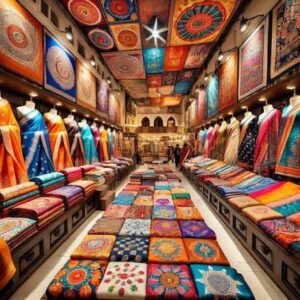
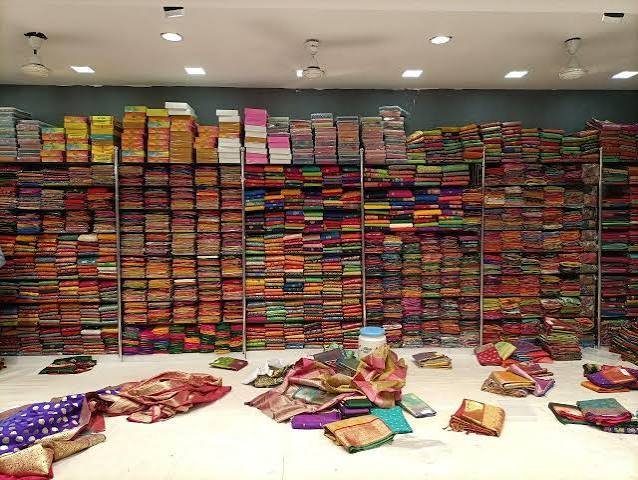
India has some enormous textile trading hubs where hundreds of manufacturers, wholesalers and distributors compete for bulk orders. Surat dominates mass-market and fashion sarees. Varanasi is famous for Banarasi sarees. Kanchipuram is synonymous with silk. Kolkata is strong in Bengali cotton and handloom products, while Jaipur specialises in printed, Bandhani and Leheriya products.
But finding the right market is only the beginning.
The real skill is learning how to compare saree wholesale rates correctly.
A ₹500 saree from one supplier and a ₹600 saree from another may not actually be the same product. Fabric quality, weaving, print, zari, finishing, blouse piece, packing, GST, minimum order quantity and transport can all change the final cost.
So this guide is not simply a list of saree markets.
We will look at where to source, what to buy, how wholesale pricing works and how to calculate whether you are actually getting a good deal.
Wholesale Saree Market India: Quick Facts
Here are a few useful facts before you start planning your sourcing trip:
- India’s population: More than 1.4 billion people, creating an enormous domestic market for apparel and ethnic wear.
- Textile employment: India’s textile and apparel sector directly employs more than 45 million people.
- Major saree sourcing hubs: Surat, Varanasi, Kanchipuram, Delhi, Kolkata, Bengaluru and Jaipur.
- Major product categories: Synthetic, georgette, chiffon, cotton, silk, Banarasi, Kanchipuram, Tant, Jamdani, Bandhani, Leheriya, printed and designer sarees.
- Typical buyers: Saree retailers, boutiques, ethnic-wear shops, online resellers, distributors, exporters and wedding-wear businesses.
- Wholesale market structure: Some markets consist of one large commercial complex, while others cover entire streets and neighbourhoods containing hundreds of manufacturers and traders.
- Wholesale pricing: There is no single “saree wholesale rate.” Rates vary enormously according to fabric, construction, design, workmanship, order volume and source.
The important lesson is simple.
Do not search only for the cheapest saree wholesale market.
Search for the market that gives you the best combination of:
Purchase price + quality + customer demand + MOQ + freight + reliability + repeat availability.
That is what ultimately determines your margin.
How Saree Wholesale Rates Actually Work
Before looking at individual markets, you need to understand wholesale pricing.
Unlike branded packaged products, there is no standard all-India wholesale price for a saree.
Even two visually similar sarees can have very different rates.
Fabric
A polyester saree, blended silk saree and pure silk saree cannot be compared simply because their designs look similar.
Fabric composition is one of the biggest factors affecting price.
Manufacturing Method
Machine-made sarees can usually be produced much faster than handloom sarees.
Hand weaving, hand block printing, embroidery and detailed zari work increase labour and production costs.
Order Quantity
A wholesaler may quote:
- Single-piece rate
- 6-piece set rate
- 12-piece rate
- 50-piece wholesale rate
- 100-piece rate
- Distributor rate
The same product can therefore have multiple prices.
Design Exclusivity
A design being produced in thousands of pieces will generally be easier to source cheaply than an exclusive boutique design produced in small quantities.
GST and Billing
Always clarify whether the quoted rate includes GST.
For a business buyer, comparing one supplier’s GST-exclusive quotation with another supplier’s final invoice value can create a misleading price difference.
Packing and Transport
Your real buying cost is not simply the saree rate.
Think in terms of:
Purchase Rate + GST + Packing + Loading + Transport + Local Delivery = Landed Cost
If Supplier A quotes ₹600 but adds ₹40 per piece in combined logistics costs while Supplier B quotes ₹625 with cheaper dispatch, Supplier B may actually be the better source.
This is exactly why serious B2B sourcing should be based on landed wholesale rates, not attractive headline prices.
1. Synthetic, Georgette and Fancy Sarees at Wholesale Rates
Surat Wholesale Saree Market, Gujarat
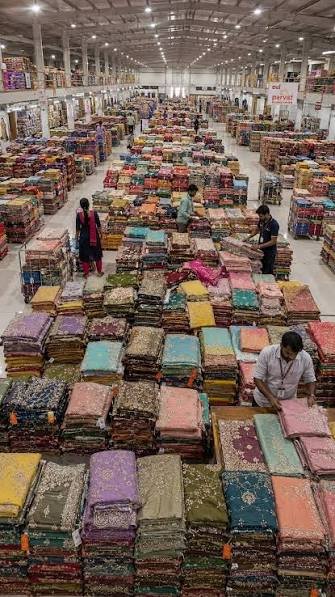
If you are planning to sell affordable and mid-range sarees in volume, Surat should probably be one of the first markets you investigate.
Surat’s Ring Road textile district consists of multiple large textile complexes rather than one single market.
These include:
- Surat Textile Market
- New Textile Market
- Abhishek Textile Market
- Vankar Textile Market
- Reshamwala Market
- Anmol Textile Market
- Millennium Textile Market
- Several adjoining textile complexes
This huge concentration of traders is one reason Surat saree wholesale rates are so competitive.
What Makes Surat Useful?
Surat sits close to a massive textile manufacturing ecosystem.
This makes it particularly strong for new designs, synthetic fabrics, printed products and fashion-led sarees.
For retailers who need fresh designs regularly rather than expensive heritage products, this can be a major advantage.
Products to Buy
Look for:
- Georgette sarees
- Chiffon sarees
- Synthetic sarees
- Printed sarees
- Embroidered sarees
- Daily-wear sarees
- Party-wear sarees
- Designer-style sarees
- Ready-made blouses
- Dress materials
- Lehenga sarees
How to Get Better Saree Wholesale Rates in Surat
Do not enter a shop and ask:
“Saree ka rate kya hai?”
That question is too broad.
Instead say something like:
“I need approximately 100 pieces of georgette printed sarees for a retail shop. My buying range is ₹X to ₹Y. Can designs be mixed within the order?”
Now the wholesaler understands that you are a serious buyer.
Ask separately for:
- MOQ
- Set quantity
- Mixed-design facility
- GST
- Packing
- Transport
- Repeat availability
- Defect replacement
What Visitors Can Expect
Expect large multi-storey buildings filled with wholesalers.
Many suppliers display sarees through catalogues or sample pieces and keep inventory packed separately.
Some businesses are happy to sell smaller quantities. Others are mainly interested in large B2B orders.
Clarify MOQ first.
Bargaining Tip
Use quantity as your negotiating tool.
Instead of saying:
“Reduce ₹20.”
Ask:
“If I take 100 pieces instead of 50, what becomes your final rate?”
That is how wholesale negotiation works.
Market Days and Timings
Most major Ring Road textile markets operate Monday to Saturday, approximately 10 AM to 8/9 PM.
Sunday is commonly the weekly closing day.
Always confirm with individual suppliers before travelling.
Location: Ring Road Textile Market Area, Surat, Gujarat.
Google Maps:
https://www.google.com/maps/search/?api=1&query=Surat+Textile+Market+Ring+Road+Surat+Gujarat
2. Bridal and Designer Saree Wholesale Market
Chandni Chowk and Katra Neel, Delhi
Delhi is useful when you want to source several categories during one trip.
The wider Chandni Chowk textile district includes Katra Neel and adjoining wholesale lanes specialising in fabrics, sarees, suits, lehengas and wedding wear.
Unlike a manufacturing hub focused on one regional saree, Delhi acts as a major distribution centre.
Products arrive here from across India.
Products to Buy
You can explore:
- Bridal sarees
- Designer sarees
- Banarasi-style sarees
- Embroidered sarees
- Organza sarees
- Silk sarees
- Party-wear sarees
- Wedding lehengas
- Dress materials
- Blouse fabrics
- Borders and embellishments
Understanding Wholesale Rates in Delhi
Delhi’s advantage is comparison.
Suppose you require bridal sarees for a store in Punjab, Haryana, Rajasthan or Uttar Pradesh.
Instead of contacting factories in five different manufacturing centres, you can compare multiple product categories within the same trading district.
You may pay slightly more than a manufacturer-direct rate on some products.
But that does not automatically make Delhi expensive.
If one wholesaler lets you mix 20 designs in a 40-piece order while a factory requires 100 pieces from one catalogue, the Delhi supplier may be much more practical for a smaller retailer.
MOQ affects your real business risk.
Dead inventory costs money too.
What Visitors Can Expect
Chandni Chowk is crowded.
Expect narrow lanes, old commercial buildings, shops on upper floors and wholesalers who may not have large storefronts.
Keep a supplier list before visiting.
Bargaining Tip
Ask every seller for the rate at three quantities.
For example:
- 12 pieces
- 50 pieces
- 100 pieces
You will quickly understand how much volume actually changes the wholesale rate.
Days and Timings
Most textile businesses operate Monday to Saturday, around 10:30/11 AM to 7/8 PM.
Sunday is commonly closed.
Location: Katra Neel, Chandni Chowk, Delhi.
Google Maps:
https://www.google.com/maps/search/?api=1&query=Katra+Neel+Chandni+Chowk+Delhi
3. Banarasi Silk Sarees Wholesale
Varanasi Wholesale Saree Market
If Banarasi sarees are an important part of your business, sourcing closer to Varanasi’s weaving and trading ecosystem makes sense.
Wholesale activity is spread across areas including:
- Chowk
- Vishwanath Lane
- Godowlia
- Thatheri Bazaar
- Adjoining textile lanes
Products to Buy
Popular products include:
- Banarasi silk sarees
- Katan sarees
- Kora sarees
- Organza sarees
- Tissue sarees
- Tanchoi sarees
- Brocade sarees
- Banarasi dupattas
- Bridal sarees
Why Banarasi Wholesale Rates Vary So Much
This is extremely important.
Do not compare two Banarasi sarees only by design.
Ask whether the product is:
- Handloom or powerloom
- Pure silk or blended
- Real zari or imitation zari
- Hand-finished or machine-finished
A cheaper saree may simply be a different product.
If your customers are buying primarily on appearance, mass-market products may work perfectly well.
If you operate a premium boutique, authenticity becomes much more important.
What Visitors Can Expect
Compared with Surat’s large textile complexes, many Varanasi suppliers operate from smaller establishments.
Take your time.
Ask suppliers to explain construction and fabric rather than simply showing you increasingly expensive designs.
Bargaining Tip
For premium products, negotiate after establishing specifications.
Otherwise you can easily end up comparing different quality grades.
Days and Timings
Many wholesale businesses operate approximately 10 AM to 8 PM, Monday to Saturday.
Individual schedules vary.
Location: Vishwanath Lane/Godowlia-Chowk, Varanasi.
Google Maps:
https://www.google.com/maps/search/?api=1&query=Vishwanath+Lane+Varanasi+Uttar+Pradesh
4. Kanchipuram Silk Sarees at Wholesale Rates
Gandhi Road, Kanchipuram
Kanchipuram is one of India’s best-known destinations for traditional silk sarees.
The Gandhi Road area contains numerous silk stores, manufacturers and suppliers.
Products to Buy
- Kanchipuram silk sarees
- Bridal silk sarees
- Contrast-border sarees
- Temple-border sarees
- Traditional zari sarees
- Silk-cotton sarees
- Wedding sarees
How to Compare Kanchipuram Saree Wholesale Rates
First establish what you are actually buying.
Ask:
- Is this pure silk?
- Is it silk cotton?
- Is it art silk?
- What type of zari is used?
- What is the saree weight?
- Is certification available where applicable?
- What quantity is required for a wholesale rate?
For an expensive silk product, paying slightly more to a dependable supplier may be better than chasing an unusually low quotation.
What Visitors Can Expect
You will find everything from relatively affordable silk-look sarees to premium bridal products.
Do not assume every saree sold in Kanchipuram is automatically identical in quality.
Bargaining Tip
If you are a retailer, ask for the trade price and explain your expected repeat quantity.
A supplier may negotiate more seriously with someone planning monthly purchases than with a one-time buyer.
Days and Timings
Many Gandhi Road textile businesses operate approximately 10 AM to 9 PM, Monday to Saturday, although individual shop schedules vary.
Location: Gandhi Road, Kanchipuram, Tamil Nadu.
Google Maps:
https://www.google.com/maps/search/?api=1&query=Gandhi+Road+Silk+Saree+Market+Kanchipuram+Tamil+Nadu
5. Saree Wholesale Market in Bengaluru
Chickpet Textile Market
For retailers in Karnataka and neighbouring states, travelling to Surat or Delhi for every purchase may not make economic sense.
Chickpet gives buyers access to a huge mixed textile market within Bengaluru.
Products to Buy
- Mysore silk sarees
- Kanjivaram-style sarees
- Art silk sarees
- Cotton sarees
- Fancy sarees
- Banarasi-style sarees
- Wedding sarees
- Uniform sarees
- Blouse fabrics
Why Chickpet Can Offer Better Landed Rates
Suppose a Surat supplier quotes ₹20 less per saree than a Bengaluru wholesaler.
If you are purchasing only 30 pieces, freight and additional logistics could remove the entire saving.
This is why you should compare:
Supplier Rate + Transport + Time + MOQ = Real Sourcing Cost
For smaller Karnataka retailers, Chickpet can sometimes make more commercial sense even if another manufacturing hub offers a slightly lower basic rate.
What Visitors Can Expect
The market is busy and parking is difficult.
Use public transport where possible.
Chickpet Metro Station provides convenient access to the textile district.
Bargaining Tip
Collect quotations from at least three suppliers before purchasing.
Also ask whether the wholesaler can send future repeat orders through WhatsApp and transport.
That saves sourcing time later.
Days and Timings
Most businesses operate Monday to Saturday from around 10 AM to 8/9 PM.
Location: Chickpet Main Road and surrounding lanes, Bengaluru.
Google Maps:
https://www.google.com/maps/search/?api=1&query=Chickpet+Market+Bengaluru+Karnataka
6. Cotton and Bengali Sarees Wholesale
Burrabazar, Kolkata
Burrabazar is one of Eastern India’s major traditional wholesale districts.
For saree traders, areas around Cotton Street, Satyanarayan Park and nearby textile lanes are particularly useful.
Products to Buy
Look for:
- Tant sarees
- Jamdani sarees
- Baluchari sarees
- Cotton sarees
- Tussar sarees
- Fancy sarees
- Banarasi-style sarees
- Dress materials
- Fabrics
How to Compare Rates
Again, quality classification matters.
A machine-made Jamdani-style saree cannot be compared directly with a genuine handloom product.
Ask sellers to separate collections according to construction and quality before discussing prices.
What Visitors Can Expect
Burrabazar is not a modern shopping mall.
It is a vast commercial neighbourhood consisting of roads, lanes, katras and individual buildings.
Research suppliers before arriving.
Bargaining Tip
If you sell low- and mid-range products, ask wholesalers to show you their fast-moving retailer range rather than simply saying “show me your cheapest saree.”
Cheap stock that does not sell is expensive stock.
Days and Timings
Most wholesale businesses operate Monday to Saturday, approximately 10 AM to 8 PM.
Location: Burrabazar/Cotton Street area, Kolkata.
Google Maps:
https://www.google.com/maps/search/?api=1&query=Burrabazar+Kolkata+West+Bengal
7. Printed, Bandhani and Leheriya Saree Wholesale Market
Sanganer and Jaipur
Jaipur is an excellent sourcing destination for retailers who want a collection that looks different from standard mass-market synthetic sarees.
Sanganer is particularly important for textile printing and manufacturing.
The wider Jaipur market also gives buyers access to Rajasthani styles such as Bandhani and Leheriya.
Products to Buy
- Sanganeri printed sarees
- Block-print sarees
- Cotton sarees
- Mulmul sarees
- Bandhani sarees
- Leheriya sarees
- Bagru prints
- Gota Patti sarees
- Printed fabrics
- Dress materials
Why Printed Saree Rates Differ
Ask how the fabric has been printed.
Possible methods include:
- Hand block printing
- Screen printing
- Digital printing
These processes have very different labour and production costs.
A buyer comparing them only on appearance may draw the wrong conclusion about price.
What Visitors Can Expect
Sanganer is geographically more spread out than a compact wholesale bazaar.
If you need large quantities, contact manufacturers before visiting.
Bargaining Tip
For custom production, negotiate on:
- MOQ
- Number of colours
- Design
- Fabric
- Printing method
- Production time
- Packing
- Repeat-order quantity
The cheapest per-piece quotation may require a much larger MOQ.
Days and Timings
Most Sanganer textile businesses operate Monday to Saturday, broadly between 9/10 AM and 7/8 PM.
Location: Sanganer, Jaipur, Rajasthan.
Google Maps:
https://www.google.com/maps/search/?api=1&query=Sanganer+Textile+Market+Jaipur+Rajasthan
Which Wholesale Saree Market Offers the Best Rates?
There is no universal answer.
| Requirement | Market to Explore |
|---|---|
| Affordable synthetic sarees | Surat |
| Fancy and fast-fashion sarees | Surat |
| Bridal and mixed wedding collection | Delhi |
| Banarasi sarees | Varanasi |
| Kanchipuram silk | Kanchipuram |
| Mixed South Indian collection | Chickpet |
| Tant and Bengali cotton | Kolkata |
| Block-printed cotton | Jaipur/Sanganer |
| Bandhani and Leheriya | Jaipur |
If your requirement is large enough, sourcing directly from a manufacturing hub can produce better rates.
For smaller retailers, however, a local wholesaler may offer:
- Lower MOQ
- Mixed designs
- Faster delivery
- Easier replacement
- Smaller inventory risk
So never assume factory direct = automatically cheaper for your business.
Calculate the complete cost.
How to Get the Best Saree Wholesale Rates
Do Your Research
Research prices before entering a wholesale market.
Look at competing wholesalers, online B2B catalogues and your local retail market.
Your objective is not to discover one magical “correct” price.
You want an approximate buying range so that you recognise an expensive or unusually cheap quotation when you hear one.
Research Average Prices Before Shopping
Compare similar products.
Do not compare a pure silk saree with a silk-blend product or hand-block printing with digital printing.
Record:
- Fabric
- Construction
- Design
- Quantity
- Supplier quotation
This makes price comparison much more meaningful.
Start Low
Leave some negotiating room.
If a supplier quotes ₹800, you do not necessarily need to accept immediately.
But do not make absurd offers.
Professional wholesalers understand their margins.
Your objective is to arrive at a realistic trade rate that works for both parties.
Be Polite and Friendly
Wholesale trade works on relationships.
A regular buyer may eventually receive:
- Better prices
- New-design information
- Easier replacement
- Short credit
- Faster dispatch
- Reserved stock
A reliable long-term supplier relationship can save more money than winning one aggressive bargaining session.
Visit Multiple Vendors
Do not rely on one quotation.
Visit at least three suppliers.
For larger orders, compare five or more.
Compare:
- Product quality
- Wholesale rate
- MOQ
- GST
- Packing
- Freight
- Replacement
- Payment terms
- Repeat availability
Consider Transportation
A saree may be lightweight individually, but hundreds of pieces require cartons or bundles.
Ask:
- Will you pack the goods?
- Is packing charged separately?
- Which transporter do you use?
- Who bears freight?
- Is transit insurance available?
- How long will delivery take?
Transport should be included when calculating landed cost.
Go Early
Wholesale markets become crowded as the day progresses.
Going early gives you more time to:
- Inspect stock
- Compare suppliers
- Negotiate
- Arrange transport
- Verify invoices
It is particularly useful in congested areas such as Chandni Chowk, Chickpet and Burrabazar.
Payment Options
UPI and bank transfers are widely used, while cash remains common for smaller transactions.
Card acceptance varies.
For larger orders, maintain proper payment records and ask for a GST invoice where applicable.
Wholesale Purchase
To get a wholesale rate, buy like a wholesale buyer.
Do not spend half an hour negotiating over one saree.
Ask:
“What is the rate for 50 pieces?”
“What about 100?”
“Can I mix designs?”
“What rate can you give if I reorder every month?”
Quantity and repeat business are your strongest bargaining tools.
Manufacturer vs Wholesaler: Where Should You Buy Sarees?
This is one of the most important questions for new retailers.
Buy Direct from a Manufacturer When:
- You require large quantities
- You can meet the MOQ
- You need repeated designs
- You want private labelling
- You need customised colours or designs
- Your sales volume justifies the commitment
Buy from a Wholesaler When:
- You need smaller quantities
- You want many different designs
- You are testing customer demand
- You do not want a large MOQ
- You need multiple saree categories
A manufacturer may offer a lower unit cost.
A wholesaler may give you lower inventory risk.
The correct choice depends on your business size.
Calculate Your Saree Landed Cost Before Buying
Suppose you purchase 100 sarees at ₹600 each.
Your buying price is:
₹60,000
But now add:
- GST
- Packing
- Freight
- Loading
- Local delivery
- Payment charges, if any
- Expected damaged pieces
Your final cost may be significantly higher.
Divide the final amount by the number of saleable sarees.
That is your real landed cost per piece.
Use that figure when calculating your retail margin.
Not the supplier’s headline wholesale rate.
Mistakes New Saree Buyers Should Avoid
Buying Too Much of One Design
A supplier may offer an excellent rate if you take a large quantity.
But if the design does not sell, you have simply converted cash into dead inventory.
Buying Only Because the Price Is Low
Ask yourself:
“Will my customer buy this?”
A ₹350 saree that never sells is more expensive than a ₹600 saree that sells quickly.
Ignoring Defect Policy
Ask what happens if you discover:
- Weaving defects
- Colour problems
- Torn fabric
- Missing blouse pieces
- Wrong designs
Get the replacement policy clear before payment.
Ignoring Repeat Availability
If one design suddenly becomes your bestseller, can the supplier reproduce it?
For many retailers, repeat availability is extremely valuable.
Comparing Different Quality Grades
This is probably the most common mistake.
Always compare like with like.
Questions to Ask Every Saree Wholesaler
Before placing a bulk order, ask:
- What is your MOQ?
- Can designs be mixed?
- What is your best rate for my quantity?
- Does the price include GST?
- Are you the manufacturer or wholesaler?
- What fabric is this?
- Is this handloom or powerloom?
- What type of zari is used?
- Is the blouse piece included?
- What is your defect replacement policy?
- Can you repeat the same design?
- How long does dispatch take?
- Can you send goods to my city?
- What are the freight charges?
- Do you provide GST invoices?
- Can I order again through WhatsApp?
These questions quickly separate serious suppliers from sellers who are interested only in a one-time transaction.
Frequently Asked Questions
Which is India’s biggest wholesale saree market?
Surat’s textile trading district is among India’s biggest saree and textile sourcing hubs, particularly for synthetic, fancy, printed and mass-market sarees.
Where can I get sarees at the lowest wholesale rates?
For mass-produced sarees, manufacturing centres such as Surat can be highly competitive.
But the lowest supplier quotation is not necessarily the lowest landed cost. Compare freight, MOQ, quality and GST before deciding.
How much cheaper are wholesale sarees?
There is no fixed percentage.
The wholesale rate depends on the saree category, quantity, supplier, fabric, manufacturing method and market conditions.
Can I buy only 10 or 20 sarees at wholesale rates?
Many wholesalers allow small orders, but the price may be higher than the rate available for 50, 100 or 500 pieces.
Always ask for quantity-wise pricing.
Which market is best for starting an online saree business?
Surat is useful for fashion and affordable products because of its large variety.
Delhi, Kolkata and Bengaluru can be useful when you need smaller mixed collections.
For a new business, testing multiple designs in small quantities can be safer than committing heavily to one catalogue.
Where should I buy pure silk sarees?
Kanchipuram is an important source for Kanchipuram silk, while Varanasi is known for Banarasi silk.
Buyers should verify fibre, weaving method and zari rather than relying only on the seller’s description.
Should I buy from a manufacturer or wholesaler?
Manufacturers are often suitable for larger orders.
Wholesalers are generally better for smaller buyers who need variety and mixed designs.
Compare the final cost and inventory risk rather than focusing only on unit price.
Can wholesalers send sarees to another city?
Yes. Many established textile wholesalers regularly dispatch goods through transport companies and couriers.
Confirm packing, freight and replacement responsibilities before ordering.
Final Thoughts
Finding a good wholesale saree market is not difficult in India.
Finding the right supplier at the right wholesale rate requires more work.
Surat is excellent for synthetic, printed and fast-moving fashion sarees.
Varanasi is the natural destination for Banarasi products.
Kanchipuram is important for South Indian silk.
Delhi offers variety.
Kolkata gives buyers access to Bengali cotton and handloom styles.
Bengaluru’s Chickpet serves South Indian retailers particularly well, while Jaipur is valuable for block prints, Bandhani and Leheriya products.
But whichever market you choose, follow the same sourcing discipline.
First survey the market.
Do not start buying immediately.
Visit several wholesalers and compare products.
Second, shortlist suppliers.
Compare identical quality, MOQ, GST, replacement and dispatch terms.
Third, negotiate according to quantity.
Your order size and repeat potential matter much more than simply asking for a discount.
Fourth, calculate landed cost.
Add transport and all other expenses before deciding which supplier is genuinely cheaper.
And finally, remember that wholesale sourcing is not only about obtaining the lowest possible rate.
The best supplier is one who can consistently provide:
- The right products
- Competitive wholesale rates
- Reliable quality
- Suitable MOQ
- Repeat availability
- Proper billing
- Efficient dispatch
- Fair replacement support
For a retailer, that reliability eventually becomes a competitive advantage.
At wholesale-rates.com, our objective is to help Indian retailers, resellers and bulk buyers understand how wholesale pricing works, identify the right sourcing markets and make better purchasing decisions.
So before your next trip to a wholesale saree market, do your homework.
Compare rates.
Check quality.
Calculate the landed cost.
Negotiate on quantity.
And buy the sarees that give your business the best margin and sell-through, rather than simply the lowest price tag.
Note: Wholesale market timings, weekly holidays, prices and individual shop policies can change. Contact suppliers directly before making a special sourcing trip, especially when travelling from another city.
See Also
- Surat Saree Manufacturer | Wholesale Saree Market Surat | Factory Price Sarees | Designer Sarees
- India’s best saree manufacturer | Surat saree wholesale market
- Wholesale Cloth Market in India: Best Markets to Buy Cloth at Wholesale Rates
- Navigating the Surat Saree Wholesale Market: The Ultimate MOQ & Sourcing Guide for Boutique Owners
- Sourcing Woolens from Ludhiana Wholesale Market: Complete Guide for Retailers